Overview
This itinerary starts and ends at Jackson Hole Airport (JAC), the only commercial airport inside a U.S. national park, and loops through Grand Teton National Park and Yellowstone before exiting through Cody. On Day 7 you can fly out of Yellowstone Regional Airport (COD) or drive a scenic loop south through Thermopolis and back to JAC. Total driving across the week runs about 450 miles. The route works best from late May through late September, when the Teton Park Road is fully open and Yellowstone's Grand Loop Road is accessible by car. If you want to see the elk rut on the Teton valley floor, target mid-September through early October, the crowds drop, prices fall 20-30 percent, and bull elk are bugling in the sagebrush flats outside Jackson every morning. For context on the full range of Wyoming experiences beyond the northwest corner, see the Wyoming Travel Guide.
The extra two days compared to a five-day trip let you move at a pace where wildlife shows up. You are not sprinting between geysers. You have time for a Cascade Canyon hike on Day 2, an afternoon at Grand Prismatic, a real dawn in Lamar Valley, and a night in Cody for the rodeo. That is the version of Wyoming worth coming for.
Day 1: Arrive Jackson, Get Your Bearings
Land at JAC and pick up your rental car, a car is required for this entire itinerary, full stop. The airport is 9 miles north of Jackson on US-89, about 15 minutes without traffic. Drive south into town and spend the afternoon getting your bearings. The Greater Yellowstone Visitor Center on North Cache Street is the most useful first stop: staff post current wildlife reports, recent bear sightings, and road conditions for both parks. The elk-antler arches on the Town Square are two minutes from there on foot.
The Town Square is also a practical place to confirm any remaining reservations and pick up bear spray if you plan any hiking. Bear spray is required in grizzly country throughout Grand Teton and Yellowstone, and canisters run about $45-55 to purchase or $12-15 per day to rent at outfitters around Jackson. For a full overview of the Jackson Hole and Tetons region, including where to base and what the pricing landscape looks like, that region guide covers the details. Plan for a low-key dinner in Jackson and an early bedtime. Day 2 starts at 6:30 a.m.
Day 2: Grand Teton National Park, Jenny Lake and Cascade Canyon
Drive north on US-89/191 from Jackson into Grand Teton National Park (entry $35 per vehicle, valid 7 days for both parks, or covered by an America the Beautiful Annual Pass at $80). Reach Jenny Lake by 7:30 a.m. before the parking lots fill. The boat shuttle across the lake runs approximately mid-June through late September, and the east-shore dock opens early. The shuttle costs roughly $18 round-trip per adult (estimated) and saves 2 miles of flat lakeside walking each direction. From the west-shore dock, the climb to Inspiration Point is 2.5 miles round-trip with about 400 feet of gain and reaches an overlook above the canyon entrance.
If the day is clear and your group is fit, continue past Inspiration Point up Cascade Canyon, a 9.7-mile loop with 1,000 feet of elevation gain that puts you well into the granite interior of the range. This is the hike that separates the Tetons from every other mountain range in Wyoming: the canyon walls rise 2,000-3,000 feet directly off the canyon floor with no foothills easing you in. Return to the boat dock by early afternoon. Before leaving the Moose area, take 10 minutes to drive the Antelope Flats Road east of the park entrance to Mormon Row, where the Moulton barn photographs best with afternoon light on the Teton peaks behind it. Schwabacher Landing on the Snake River, 4 miles north of Moose Junction, is worth a stop at golden hour for river reflections and possible moose along the bank.
Day 3: Northern Grand Teton to Yellowstone, Old Faithful and Grand Prismatic
Drive north on the Teton Park Road from the Moose area through the park to the Colter Bay area (about 30 minutes), then continue north on US-89/191/287 through the John D. Rockefeller Jr. Memorial Parkway to Yellowstone's South Entrance. Budget 75-90 minutes for the full drive from Moose to Old Faithful in summer, entrance queues at the South Entrance can back up significantly in July and August, and the drive from the entrance to Old Faithful covers about 30 miles of two-lane road through the park interior. Head directly for Old Faithful. The Visitor Education Center posts the next predicted eruption time, usually accurate within 10 minutes. The Upper Geyser Basin boardwalk loop covers 3 miles and passes Castle Geyser, Riverside Geyser, Grand Geyser, and Morning Glory Pool, allow two hours.
In the afternoon, drive 3 miles west from Old Faithful to the Midway Geyser Basin. The flat boardwalk gives you a ground-level view of the Grand Prismatic Spring's vivid rings of yellow, orange, and green, but the Fairy Falls Trail overlook, about 1 mile round-trip up a gentle hillside, puts the full 370-foot-wide spring in context. The overlook view is substantially better than the boardwalk for photographs and for comprehending the scale of the thermal feature. Reach Canyon Village for the night, about 40 minutes northeast of Old Faithful. Inside the park lodging is covered under the Where to Stay section below, but tonight at Canyon Lodge is the most important reservation in this entire itinerary. The national parks guide covers both parks' infrastructure, entry systems, and seasonal road schedules in detail.
Day 4: Grand Canyon of the Yellowstone and Hayden Valley
Day 4 is shorter on driving and longer on paying attention. Start at the Grand Canyon of the Yellowstone, 5 minutes from Canyon Village. The South Rim Drive to Artist Point is the straightforward stop: a flat 20-minute round-trip walk from the parking area to the viewpoint that puts the Lower Falls of the Yellowstone River, a 308-foot drop into a 1,000-foot-deep canyon of yellow and orange rhyolite, directly in front of you. The North Rim adds two more named viewpoints and the Brink of the Upper Falls trail, which descends to a platform just above the Upper Falls. Both rims together take about two hours.
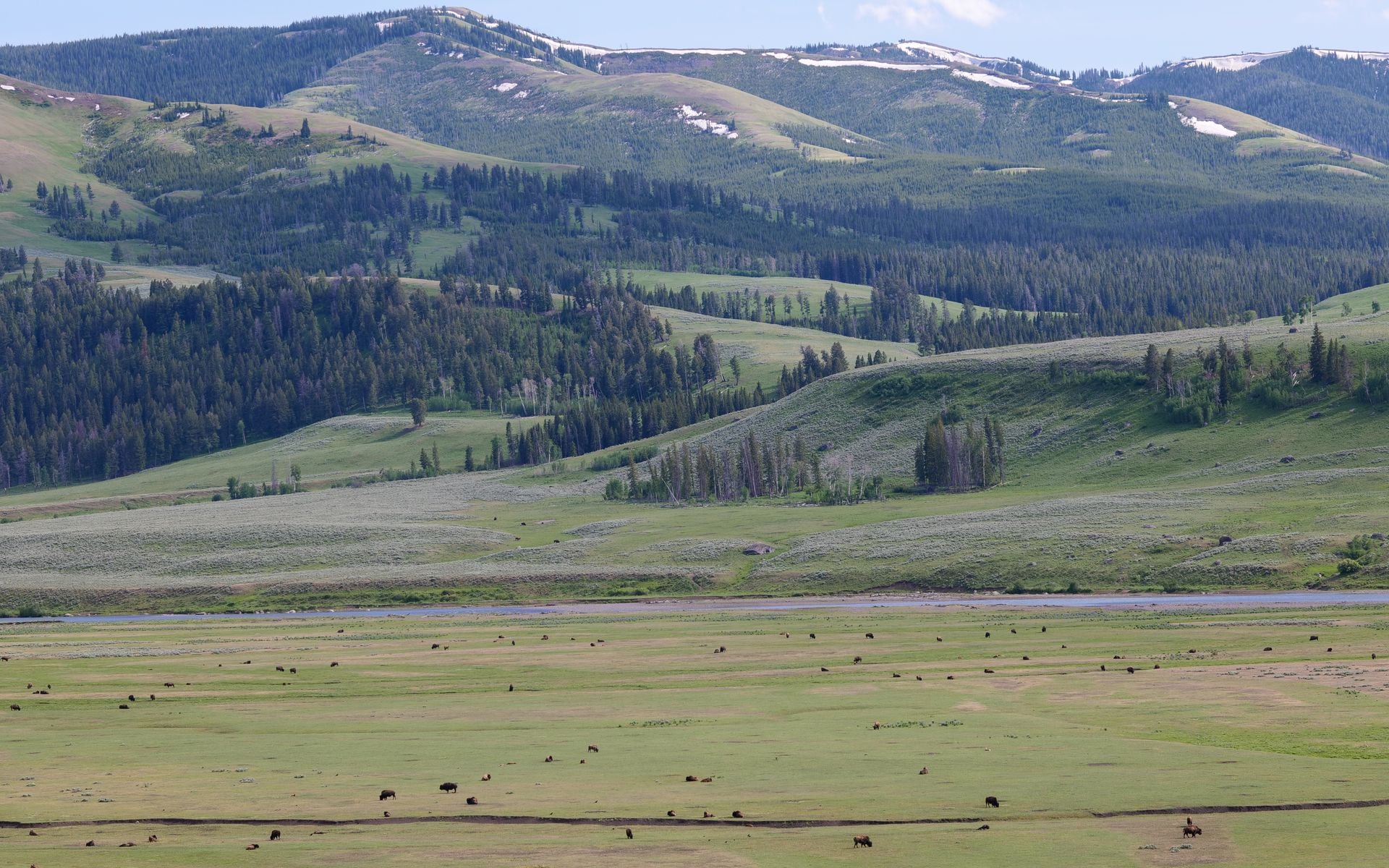
From Canyon, drive 16 miles south on the Grand Loop Road through Hayden Valley, the widest open stretch of meadow in the park. Bison herds in the hundreds, coyotes working the meadow edges, and grizzly bears on the upper slopes above the Yellowstone River show up here reliably from April through October. The Hayden Valley pullouts along US-20 are the most productive wildlife viewing from a car that Yellowstone offers, more reliable in morning and evening, but bison are there throughout the day. Stop at Mud Volcano 2 miles south of the valley for the Dragon's Mouth Spring and the bubbling Mud Caldron. Both are a 15-minute walk from the parking lot. The sulfur smell announces the area before you see it.
Day 5: Lamar Valley at Dawn, Mammoth Hot Springs
Set an alarm for 5 a.m. and drive 40 miles from Canyon Village northeast to the Lamar Valley, arriving before 7 a.m. The Lamar is Yellowstone's wolf-watching corridor, and the resident packs move across the hillsides at first light from October through April with particular reliability. Summer wolf sightings are less predictable but not uncommon, and the valley delivers bison herds of several hundred animals, pronghorn, and grizzly bears on the upper slopes essentially any morning you show up. Park at the Slough Creek pullout or along the Lamar River stretch between Pebble Creek and Confluence viewpoints and scan the hillsides slowly with binoculars. Eight-power glass is the minimum; spotting scopes are worth borrowing from a guided outfitter for this stop. If you want a dawn patrol with a naturalist guide, this is the morning to have one booked. The Wyoming Wildlife Safari itinerary lays out exactly how to build a trip around Lamar Valley and the other top wildlife corridors across the state.
After two to three hours in the Lamar, drive west 45 minutes to Mammoth Hot Springs at the park's north end. The Upper and Lower Terraces at Mammoth are the most architecturally striking thermal feature in Yellowstone: travertine cascades down a hillside in layers of white, orange, and pale green formed by hot water depositing calcium carbonate above ground. The boardwalk loop takes about 45 minutes. The Roosevelt Arch at the Gardiner entrance gate, 5 miles north of Mammoth, is worth a brief drive-by for its historical marker, it was dedicated in 1903 by President Theodore Roosevelt. Return to Canyon Lodge for your second night, or position at Mammoth Hot Springs Hotel if you have a reservation there.
Day 6: East Entrance to Cody, Buffalo Bill Center, Cody Nite Rodeo
Drive from Canyon Village east and south around Yellowstone Lake through Fishing Bridge to the East Entrance, about 30 miles and 45 minutes. Exit the park and descend the North Fork of the Shoshone River on US-14/16/20, also signed as the Buffalo Bill Cody Scenic Byway. The 52-mile drive from the East Entrance down to Cody takes about 60 minutes and follows volcanic rock formations through the Wapiti Valley before the canyon walls narrow dramatically in the final 20 miles. It is one of the most abrupt transitions in Wyoming: inside Yellowstone at 7,800 feet elevation, then canyon walls pressing both sides of the highway, then the wide Bighorn Basin floor opening out around Cody.
Spend the afternoon at the Buffalo Bill Center of the West on the west side of Cody, a five-museum complex covering Plains Indian art and material culture, wildlife of the Greater Yellowstone, firearms history, and the life of William F. Cody. Admission runs approximately $25 adults, $18 for ages 6-17 (estimated). A focused visit covering two or three wings takes about two hours. The Cody Nite Rodeo runs every evening from June 1 through August 31, starting at 8 p.m. at Stampede Park on Rodeo Drive. Tickets run approximately $15-22 per person (estimated). This is a professional nightly rodeo, not a once-a-year festival event, and it draws working cowboys competing in bull riding, saddle bronc, barrel racing, and team roping. It is one of the few places in Wyoming where you can watch rodeo on a random Tuesday in July without planning around a specific event weekend. Stay in Cody tonight, where room rates run $100-200/night, noticeably lower than Jackson.
Day 7: Departure Options, Fly Cody or Loop Through Thermopolis
Two clean options for your last day. The first: fly out of Yellowstone Regional Airport (COD), which is about 3 miles east of downtown Cody. Drop your rental car, clear security in a small regional airport, and you are done. COD connects through Denver (DEN) and Salt Lake City (SLC) on most itineraries. Check current schedules when booking, as COD's seasonal service shifts from year to year.
The second option is worth the drive if you have a mid-afternoon or evening flight from JAC or are adding a night. From Cody, drive south on Wyoming Route 120 about 65 miles to Thermopolis and Hot Springs State Park (free to enter). The State Bath House offers free soaks in the large mineral pool, one of the few genuinely free thermal soaks in the American West, and the spring complex produces roughly 18 million gallons of mineral water daily. Plan 45 minutes to an hour there. From Thermopolis, US-20 south follows the Wind River Canyon, a 10-mile stretch where the highway and river squeeze between canyon walls that rise 2,500 feet off the valley floor. It is a short drive but one of the more dramatic canyon passages in Wyoming. Continue west through Shoshoni on US-26 and then north on US-191 back toward Pinedale and eventually the Jackson Hole valley, a total drive of about 3.5-4 hours from Cody. The Yellowstone and Grand Teton Road Trip itinerary offers a tighter two-park version of this route if you are planning a follow-up trip or comparing formats before booking.
Where to Stay
In Jackson (Days 1-2), lodging ranges widely. Properties within walking distance of the Town Square run $250-450 per night in July and August (estimated). The Elk Country Inn on West Pearl Avenue and the Anvil Motel on North Cache Street offer more modest rates closer to $150-200/night (estimated) without sacrificing location. Budget travelers often base in Wilson or Victor, Idaho, 20-30 minutes west over Teton Pass on WY-22, where rates run 30-40 percent lower than Jackson.
Inside Yellowstone (Days 3-5), Canyon Lodge is the right geographic base for this itinerary, it puts you within 40 miles of both Lamar Valley and Old Faithful, which matters for Day 5's early start. Canyon Lodge rates run approximately $200-320 per night (estimated). Old Faithful Inn is Yellowstone's most iconic lodging, a 1904 log structure with lobby ceiling timbers 65 feet overhead, but it keeps you 40 miles from Lamar Valley for the day you need to be there at dawn. If Canyon Lodge is sold out, Fishing Bridge RV Park and Canyon Campground are the fallback inside the park. For Cody (Day 6), the historic Irma Hotel on Sheridan Avenue was built by Buffalo Bill Cody in 1902 and remains an operating hotel with rooms running approximately $130-190/night (estimated) in summer. Check the Wyoming Travel Guide planning section for a full breakdown of where to stay organized by park access and region.
Book These Ahead
Yellowstone in-park lodging is the most time-critical reservation here. Xanterra, the park concessioner, releases rooms approximately 13 months before the travel date. Canyon Lodge for late June, July, and August fills within days of release. Set a calendar reminder and book in the opening window, January for the following summer. If you miss it, check the cancellation queue in April and May as plans shift.
The Jenny Lake boat shuttle in Grand Teton runs first-come, first-served with no reservation option. Arrive at the east-shore dock by 8 a.m. in July or you may wait 30-45 minutes in queue. Guided Snake River float trips in Grand Teton book 4-6 weeks ahead for summer dates; outfitters run half-day and full-day floats for roughly $70-100 per adult (estimated). If you want a private wildlife guide for Lamar Valley, budget $200-450 for a half-day naturalist (estimated) and book at least six weeks ahead for summer. These guides are the fastest way to locate wolves and understand what you are looking at in the valley. Bear spray can be rented at Jackson outfitters for $12-15 per day or purchased for $45-55 if you plan to hike frequently.
Frequently asked questions
Is 7 days enough for Wyoming?
Seven days covers the northwest corner of Wyoming well, including two full days in Grand Teton, three days in Yellowstone, and a day in Cody. It does not reach the Wind River Range, Sheridan, the Bighorn Mountains, or Cheyenne. Wyoming is genuinely large, Jackson to Cheyenne is most of a day of driving, so think of seven days as the first chapter. If your primary goal is wildlife rather than two-park scenery, the Wyoming Wildlife Safari itinerary builds a focused trip around the best viewing seasons.
What time of year is best for this 7-day Wyoming itinerary?
Late June through September is the primary window. July and August are busiest, with entrance queues at both parks and lodging sold out months ahead. Mid-September through early October is the most underrated window: the elk rut is active on the Teton valley floor, crowds drop noticeably, lodging prices fall 20-30 percent, and all roads remain open. May and early June work if you are flexible about potential snow on higher passes and some Yellowstone roads not yet open. Most of Yellowstone closes to cars from early November through late April.
Do you need a car for this itinerary?
Yes. There is no meaningful transit between Jackson, Yellowstone's interior, and Cody. Car rentals at JAC are available at the airport terminal. Book early for summer, inventory at JAC runs short by mid-May for July and August travel. If you fly out of COD on Day 7, confirm the one-way rental return surcharge between JAC and COD when booking, as this fee varies significantly by company.
How much does 7 days in Wyoming cost?
Budget roughly $3,500-6,000 for two people covering lodging, entry fees, meals, fuel, and bear spray, not including flights. An America the Beautiful Annual Pass ($80) covers entry to both Grand Teton and Yellowstone and pays for itself immediately. Cody lodging is the most affordable stretch, running 40-50 percent less than Jackson. The biggest variable is in-park lodging: Old Faithful Inn runs $300-400 per night in summer, while Canyon Lodge is $200-320 (both estimated). Eating outside park boundaries in Jackson or Cody saves significantly versus in-park cafeterias.