What to Expect
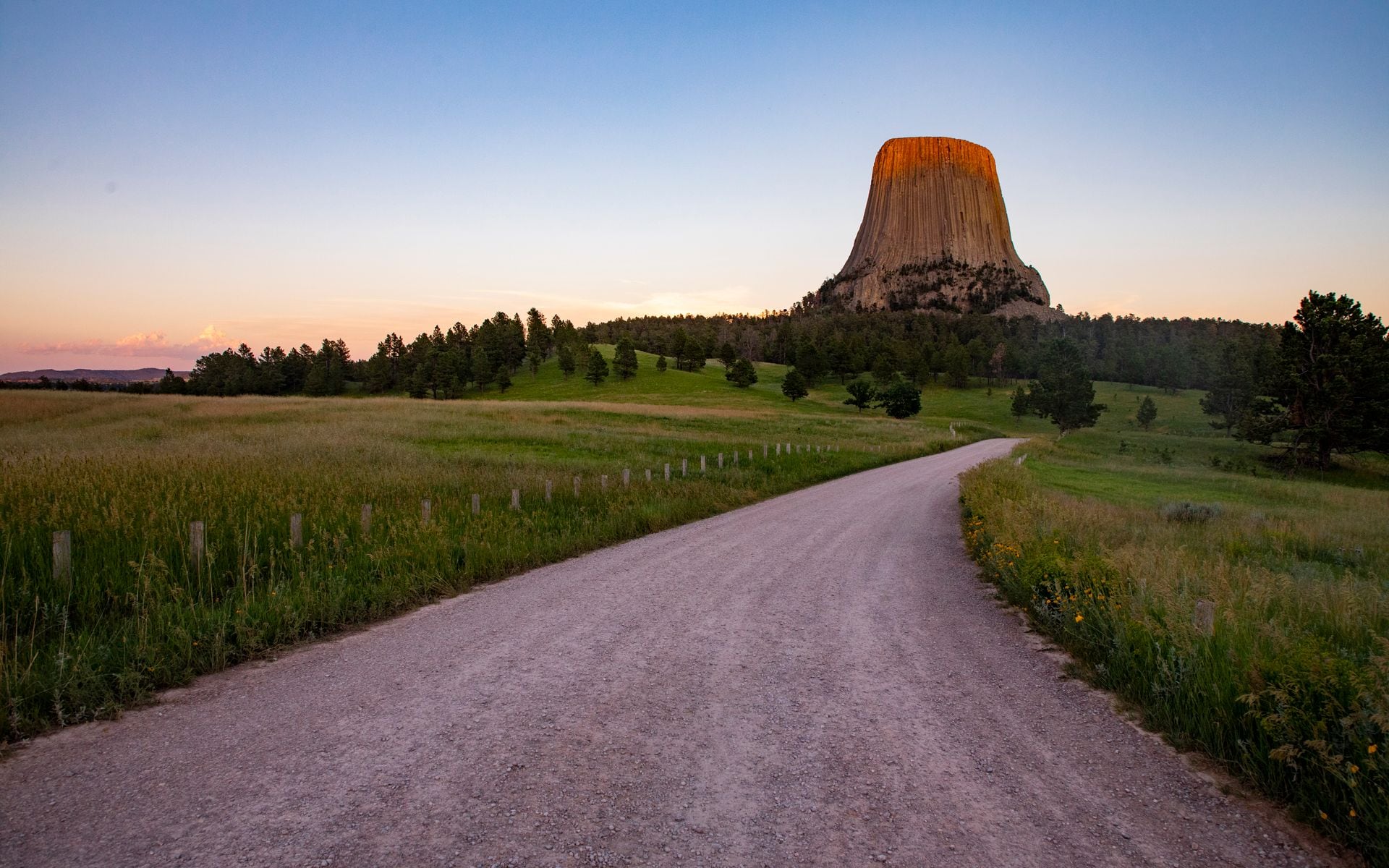
Devils Tower, known as Mato Tipila (Bear Lodge) in Lakota, formed when a mass of magma pushed upward through sedimentary rock roughly 50 million years ago and cooled into hexagonal columns underground. Erosion stripped the surrounding layers away over millions of years, leaving the column standing on its own above the pine forest and grassland of northeastern Wyoming. Theodore Roosevelt declared it the first U.S. national monument in September 1906, and today it draws around 500,000 visitors a year without the crowd density you get at Yellowstone.
From the entrance station on Wyoming Highway 24, a paved park road winds 3 miles to the visitor center and main trailhead. You can see the tower from the highway long before you reach the gate, and the view from the parking area makes the scale register in a way photographs do not quite capture. The hexagonal basalt columns average 6 to 8 feet across and run vertically from the talus slope at the base to the summit plateau. Prairie dogs occupy a large colony in the flats near the picnic area, white-tailed deer graze through the meadows at first light and dusk, and the Belle Fourche River cuts north through the valley below.
What to Do There
The Tower Trail is a paved 1.3-mile loop around the entire base. At a walking pace it takes 30 to 45 minutes, though most people add time to stand and look up at the column cracks and watch light shift across the rock face. The full circuit gives you the widest range of viewing angles and puts you close enough to the talus slope to appreciate how large the individual columns are.
Rock climbing is the other major draw. Devils Tower has over 220 established routes, nearly all of them crack climbs following the vertical joints between columns. The Durrance Route (rated 5.7), first ascended in 1938, remains the most-traveled line to the summit plateau and is considered a moderate classic. More technical lines on the north and south faces go considerably harder. Any commercial guiding or instruction on the tower requires a National Park Service permit; the NPS website lists current outfitters. Unguided climbing is open to anyone with the skills, but bring a solid rack of cams in the hand and fist size range.
One thing to understand before you go: the Lakota, Northern Cheyenne, Crow, Kiowa, and more than 20 other tribal nations consider Bear Lodge a sacred site and hold ceremonies there. The NPS asks climbers to voluntarily stay off the tower during June, and roughly 80 percent have historically honored that request. If you are visiting in June for hiking and photography, the trails are open and the base loop is quieter than in July or August.
Two shorter side trails offer different views. The Valley View Trail (0.6 miles) crosses open meadow on the south side and is less traveled than the main loop. The Red Beds Trail (2.8 miles) makes a longer circuit through ponderosa pine and passes the distinctive iron-rich red soil formations on the tower's flanks. The visitor center has exhibits covering the geology, the tribal history of the site, and the climbing history, and the rangers there can point you toward the best angle for morning photography.
Getting There and Access
Devils Tower sits 6 miles north of Hulett and 27 miles north of Sundance via Wyoming Highway 24. From I-90, take exit 185 at Moorcroft and drive north on WY-110 then WY-24, about 25 miles total. From Rapid City, South Dakota, plan about 90 minutes west on I-90 to exit 185. The nearest Wyoming city with commercial air service is Gillette (GCC), roughly 55 miles west; budget about an hour's drive east on I-90 and north on WY-24 from there. La Quinta Inn & Suites by Wyndham Gillette, on East Boxelder Road near I-90, is the most practical chain base in Gillette for a Devils Tower overnight.
For visitors building a Wyoming itinerary, Sheridan is about 130 miles west and makes a capable two-night base for both Devils Tower and the Bighorn Mountains. The full Sheridan & the Bighorns region pairs naturally with a Devils Tower stop and gives you more to do in northeast Wyoming than you can cover in a weekend. Many visitors instead base in the Black Hills around Rapid City, pairing Devils Tower with Mount Rushmore and Custer State Park in a loop that requires no backtracking. Both approaches work; what you get from the Wyoming side is more open road and fewer rental-car convoys.
Best Time to Go
May through September is the reliable window. July is the peak: parking lots fill by mid-morning on weekends and the Tower Trail sees steady foot traffic from 8 a.m. onward. Arriving at opening, generally 7 a.m. in summer, puts you on the base loop while the tower is still in dawn light from the east and the prairie dogs are most active. By 10 a.m. on a July Saturday, the lot is full and the trail is busy.
September and early October offer the most comfortable experience: temperatures in the 50s and 60s Fahrenheit, cottonwoods along the Belle Fourche going gold, and parking that rarely requires circling. Snow can arrive in late October and occasionally dusts the tower in late spring snowstorms, but the park road stays open year-round and no timed-entry reservation system is in place.
June sits in an unusual position. It has fewer visitors than midsummer, comfortable temperatures, green grass from spring rains, and active prairie dogs. But it is also the voluntary climbing-closure month. If you are visiting to hike and photograph, June is perfectly fine. If you are a climber and the summit is the goal, choose any other month.
Good to Know
Entrance fees run approximately $25 per vehicle or $15 per pedestrian and cyclist (estimated 2025 rates). The America the Beautiful Annual Pass covers admission and is worth buying if you are hitting multiple federal lands on the same trip. There is no lodging inside the monument, but Belle Fourche Campground sits right at the base: 45 sites, approximately $18 per night, first-come first-served. In July and August, sites fill by noon most days, so arrive early or have a backup plan in Hulett, 6 miles south, where a small motel and a gas station cover the basics.
The monument is a sacred site, and the NPS asks visitors to stay on marked trails, keep noise reasonable near the base, and not place offerings directly on the tower. Designated trees near the visitor center are available for hanging prayer bundles if your tradition calls for it. Treating the site with that understanding costs nothing and matters to the communities whose relationship with Bear Lodge long predates the national monument designation.
Within Wyoming, Devils Tower fits naturally as a day trip or overnight add-on at the tail end of a northeast Wyoming loop based out of Sheridan, or as a standalone stop on an I-90 drive toward the Black Hills. It sits five or more hours from Yellowstone and the Tetons by any route, so it does not fold easily into a parks-only itinerary. For the larger National Parks picture in Wyoming, Devils Tower is worth treating as its own separate trip anchor rather than a park-day tack-on. Travelers who want a complete northeast Wyoming experience sometimes combine it with the Bighorn Mountains and one of the working guest ranches in the foothills, many of which appear in the Best Dude Ranches in Wyoming guide.
Frequently asked questions
Is Devils Tower worth a special trip, or better as a road-trip add-on?
It works well as both, but it earns the most from a road-trip circuit. On its own, two to four hours at the monument covers the base loop, visitor center, and time to watch climbers. Paired with Mount Rushmore, Custer State Park, and Badlands National Park, it fits into a natural three-to-four-day Black Hills loop from Rapid City. From a Wyoming base in Sheridan, it pairs with the Bighorn Mountains for a strong two-night northeast Wyoming itinerary. The drive in from I-90 on Wyoming Highway 24, with the tower appearing on the horizon above the plain, is one of the more dramatic approaches to any landmark in the region.
Can you climb Devils Tower without a guide?
Yes. Unguided climbing is permitted for anyone with the necessary skills. The tower is almost entirely crack climbing, following the vertical joints between basalt columns, so you need solid hand and fist jamming technique and a rack of cams in the 0.75-inch to 4-inch range to cover most routes. The Durrance Route (5.7) is the standard moderate summit line. Commercial instruction or guided ascents require a National Park Service-permitted outfitter. Pick up a current route topo at the visitor center or download the NPS climbing guide before your trip. Remember that June is the voluntary closure month for all climbing.
How long should you plan for a visit to Devils Tower?
Two to four hours covers the Tower Trail loop, visitor center, and enough time to find a good angle on the column cracks and watch the prairie dog colony. Add another hour to 90 minutes if you hike the Red Beds Trail as well. Climbers heading for the summit should plan a full day: most parties start at or before first light, account for a half day on the route, and some time on the summit plateau before rappelling. If you are staying at Belle Fourche Campground, you will have early-morning and evening light on the tower that day visitors rarely get to see.