Most of Yellowstone shuts to private vehicles from early November through late April. The road to Old Faithful, the Grand Canyon of the Yellowstone, the Hayden Valley, and nearly all of the interior go quiet to cars. What stays open is more interesting than most people realize, and the park in January looks nothing like it does in July.
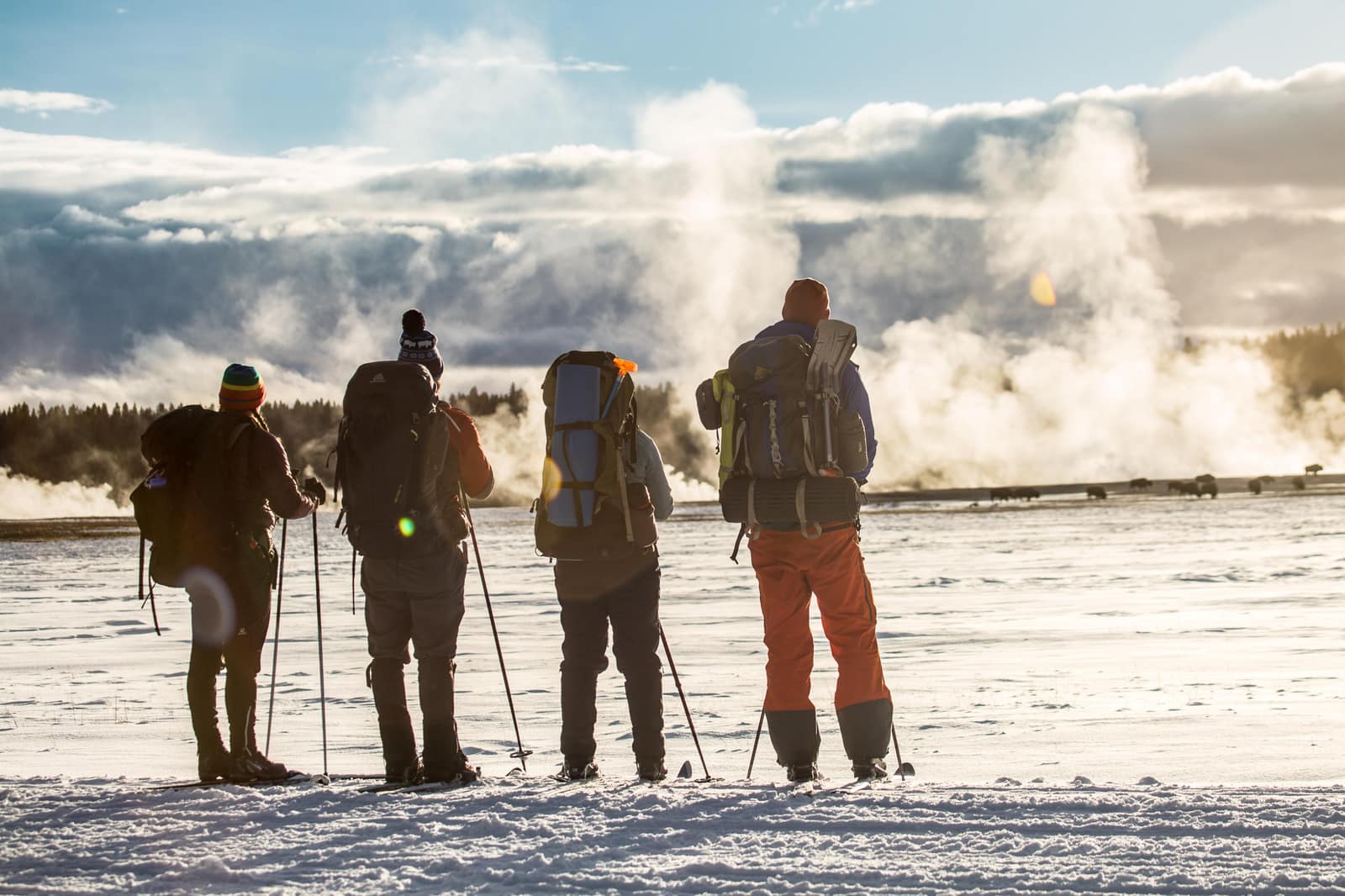
Yellowstone in winter draws a different kind of visitor: people who want wolves visible against snow in the Lamar Valley at 7 a.m., bison parked beside thermal vents with steam freezing in their fur, and Old Faithful erupting into air cold enough to turn the column into a dense wall of ice crystals. Getting there takes a snowcoach or snowmobile, some planning, and a willingness to dress for serious cold. Here’s what the planning actually looks like.
Which Roads Close and Which Stay Open
Yellowstone does not close completely in winter. The North Entrance at Gardiner, Montana stays open to private cars year-round, and the road from Gardiner south through Mammoth Hot Springs remains drivable as long as conditions allow. The Northeast Entrance at Cooke City is also accessible from the north via Gardiner and the Lamar Valley road, which is typically the last road in the park to close to wheeled vehicles each fall and the first to reopen in spring.
Everything else goes to groomed snow surface for snowcoaches and snowmobiles only. The West Entrance at West Yellowstone closes in early November. The South Entrance near Flagg Ranch and the East Entrance near Cody close around the same time. Between November and late April, if you want to reach Old Faithful, Norris Geyser Basin, the Grand Canyon of the Yellowstone, or the Hayden Valley by private car, you can’t. You need a guide.
Check the NPS road status page at nps.gov/yell/planyourvisit/hours.htm before you finalize any winter trip dates. The dates shift by a week or two depending on snowpack.
Snowcoach vs. Snowmobile: How to Decide
Both are legitimate ways in. The choice comes down to group size, budget, physical comfort, and how much independence you want.
Snowcoaches are enclosed, heated vehicles that carry 10 to 15 passengers. You sit, you look out large windows, and a guide narrates the route. Tours depart from West Yellowstone (the main hub), Flagg Ranch on the southern end, and occasionally from Mammoth. A day tour from West Yellowstone to Old Faithful runs roughly $150 to $200 per adult. Multi-destination tours covering Norris or the Grand Canyon of the Yellowstone cost more. The appeal is straightforward: you’re warm, you don’t need special gear beyond warm clothing, and you don’t have to operate anything.
Snowmobiles go where snowcoaches don’t, move faster, and give you a stronger sense of actually being out in the park rather than riding through it. All private snowmobile use in the park requires a licensed guide, so you’re not renting a sled and going solo. Guided snowmobile day tours from West Yellowstone typically run $200 to $300 per person for a full day. You need warm snowmobile-specific gear, either rented from your outfitter or brought from home: insulated suit, balaclava, and waterproof gloves. If you’ve never ridden a snowmobile, most outfitters handle first-timers. If you have young children with you, snowcoach is the easier call.
Both modes cover the main thermal features and most wildlife corridors during a full-day trip. If seeing wolves or the Lamar Valley is the priority, choose a tour that specifically routes through the north end of the park.
Where to Watch for Wildlife
Winter Yellowstone produces some of the most reliable large-predator viewing in North America, and two areas drive most of it.
The Lamar Valley in the park’s northeast corner stays accessible from the North Entrance by car. Drive south from Gardiner through Mammoth and east through Tower-Roosevelt junction into the valley. The Lamar is a broad, open river valley where wolf packs move through regularly. January and February are the peak months for wolf activity: packs are at full winter size, tracks show clearly in the snow, and the cold long nights mean wolves are often moving through the valley at dawn and dusk when the light is usable for spotting. Regulars bring spotting scopes of 20x-60x power. The wolves themselves may be a mile or more away and dark shapes against white terrain, but that’s the experience. It’s patient, quiet, and specific in a way that wildlife watching in summer is not.
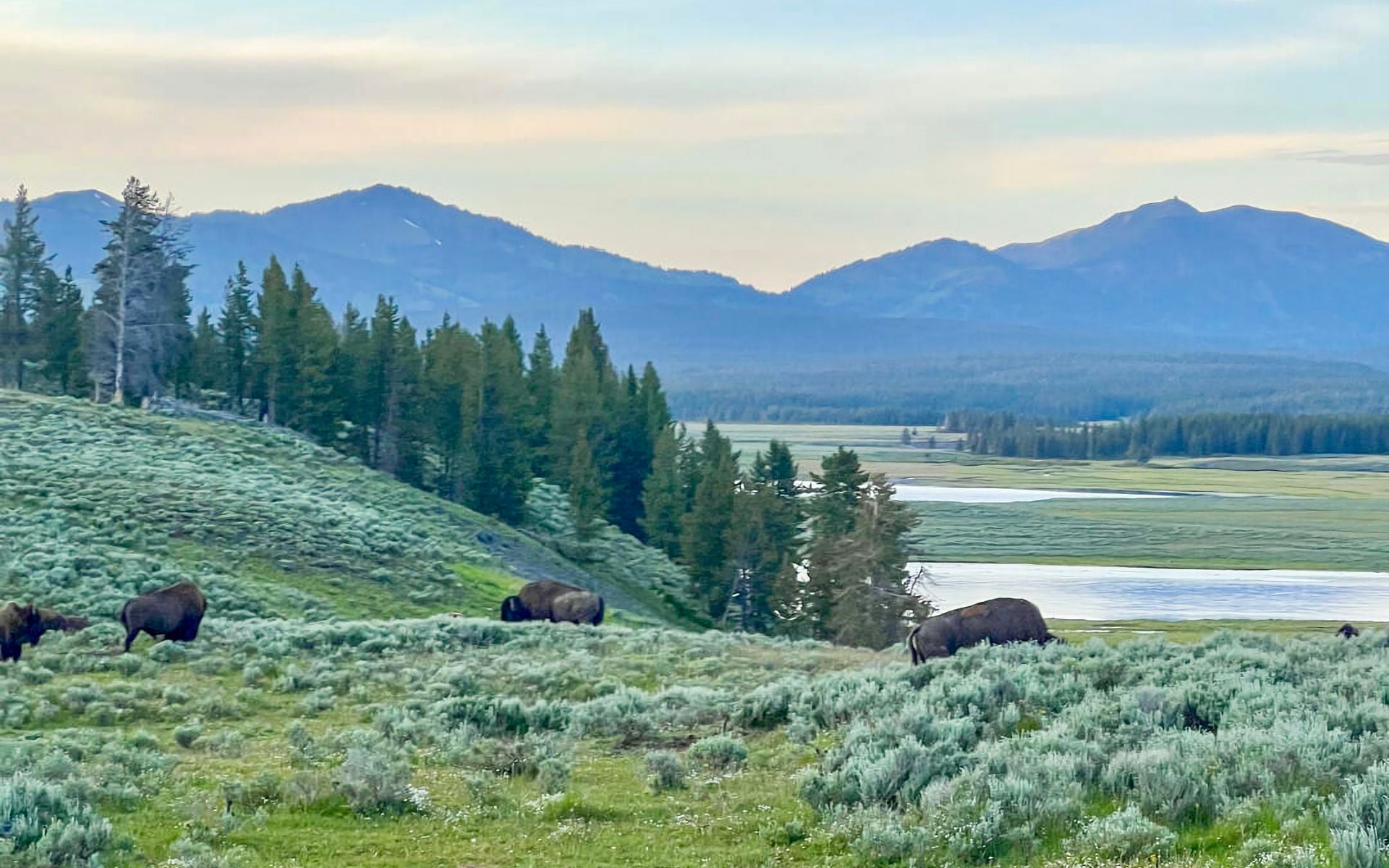
The Hayden Valley in the park interior, accessible by snowcoach, concentrates bison near geothermal features in winter. Bison in Yellowstone understand thermal areas: they stand near hot springs and vents for warmth, and in January they cluster in Hayden and around the Firehole River basin in numbers you won’t see from a July road. The contrast, dark-coated bison against white snow with steam rising around them, is visual in a way that photographs badly and stays with you anyway.
Grizzlies den from November through March and are not visible. Black bears are also down. If seeing bears is part of your plan, summer or fall is the season. Wyoming wildlife watching covers guided tour options for bears and other species in their active months.
Thermal Features in the Cold
Old Faithful still erupts every 44 to 120 minutes in winter, same as summer. What changes is the atmosphere around the eruption. When air temperatures drop to minus 10 or minus 20 degrees Fahrenheit, the water column hits the air and turns into a roaring column of steam and ice crystals. The vapor freezes on nearby trees and creates structures called hoarfrost that look like something assembled, not grown. Grand Prismatic Spring, normally visible from the rim boardwalk, generates more steam in cold air, and the bacterial mats around its edges run their full orange-to-blue color spectrum without summer’s crowds.
Norris Geyser Basin, which has some of the hottest and most acidic thermal activity in the park, is accessible by snowcoach and worth including on any interior winter tour. The basin sits at around 7,500 feet and looks alien in the snow, with steam rising from every vent and water pooling in vivid yellow and white silica deposits against the white background.
For the geothermal soaking experience that’s accessible by car without a snowcoach: the Boiling River near Gardiner is a short walk from the Mammoth Hot Springs Trailhead where a natural hot spring meets the Gardner River. When it’s open (check NPS for current status, as closures happen periodically), you can soak in water that runs 95 to 105 degrees Fahrenheit while the surrounding canyon sits at zero.
Where to Stay for a Winter Yellowstone Trip
Three base options, each with a different tradeoff.
Old Faithful Snow Lodge: The one option inside the park open in winter, right at Old Faithful. Rooms run around $200 to $300 per night in winter (the park’s low season). Staying here puts you a short walk from the geyser at dawn when no day-tour crowds have arrived, and you’re inside the park when snowcoach day visitors return to West Yellowstone at 5 p.m. Reservations through the park’s lodging concessionaire book out months ahead, especially over the holiday period and in February. Book early.
West Yellowstone, Montana: The primary staging town for winter tours. Dozens of motels and outfitters operate here; lodging runs $80 to $200 per night. This is your option if you want to do multiple snowcoach or snowmobile days and keep costs lower than in-park lodging. West Yellowstone is in Montana, a five-mile drive from the park’s West Entrance.
Gardiner, Montana: At the north entrance, accessible by car year-round. Smaller selection of motels and a quieter vibe. If your winter Yellowstone plan centers on the Lamar Valley and wolf watching, staying in Gardiner cuts the drive significantly and lets you be at a valley pullout before first light without leaving town at 4 a.m.
Jackson is a 55-mile drive south of the South Entrance, which is closed to cars in winter. Using Jackson as a base for Yellowstone winter touring adds snowcoach pickup logistics and substantial distance. It works well if you’re combining a winter Yellowstone day with skiing at Jackson Hole, but it’s not the most practical solo base for Yellowstone-focused touring. The Wyoming in winter guide covers the full Jackson and ski resort picture for anyone building a longer trip.
Timing, Costs, and What to Wear
The winter season runs mid-December through early March. The Christmas and New Year’s window (Dec. 26 to Jan. 2) sees the highest demand for snowcoach tours and in-park lodging. If you can go in late January or February instead, you’ll find tour availability easier and wildlife activity at its peak.
January and February temperatures at park elevation (7,000 to 8,000 feet): daytime highs in the teens to low 20s Fahrenheit, overnight lows near 0 or below. Wind in open valleys drops felt temperatures 15 to 20 degrees further. Budget your clothing accordingly: a warm base layer, an insulating mid-layer, and a waterproof outer shell rated for real cold. Gaiters over snow boots if you’re walking any distance. Wool or synthetic face coverage for any snowmobile day. Cotton kills in this temperature range; leave it home.
For a full day snowcoach tour, budget $150 to $200 per adult plus equipment rental if needed. For snowmobile, $200 to $300 per adult plus gear rental. In-park lodging adds $200 to $300 per night. A two-night, two-day tour trip out of West Yellowstone runs roughly $700 to $1,000 per person in lodging and tours before you account for flights and driving.
Planning the Trip
The basic sequence: pick your dates (avoiding the holiday peak if flexibility allows), book tours and lodging as far ahead as possible, and decide whether the Lamar Valley wolf experience is something you want to layer in as a separate car-accessible day.
The Yellowstone National Park page covers what the park looks like across all seasons. For the Cody and Yellowstone Country region, including the East Entrance approach that’s closed in winter, the region hub has the full multi-season picture. The snowmobiling page covers the guided snowmobile operators working in and around the park.
Winter Yellowstone is not for everyone: the cold is real, the logistics require booking ahead, and some of the park’s biggest summer draws (waterfalls, the Teton views from the South Entrance corridor) are either inaccessible or buried. What you get instead is a park that operates at a slower frequency, with the thermal features running more visibly than in warm weather, and wildlife in conditions where they’re visible and concentrated in ways summer doesn’t produce. If that trade sounds right, the planning is straightforward.